Akureyri Botanical Garden (Lystigarðurinn)
This is a seriously substantial botanical garden on the outskirts of Akureyri just 60 miles or so from the Arctic Circle! Akureyri is on the northern coast of Iceland. We were lucky to get away in May 2022 for a long-planned road trip round the Icelandic Ring Road. Our first stop out of Reykjavik was to visit Akureyri, a town of around 18,000 people. The place had caught my attention because they started planting the Kjarnaskogur (Kjarni Forest) back in 1952, some 800 ha owned by the Municipal Council, a forest intended to encircle the town. The Kjarni Forest now offers a major recreational site for many visitors. As it happened we did not get to the forest (our tight schedule focused on waterfalls and whalewatching) but we did manage to visit the Akureyri Botanical Garden.
Founding history of the Botanical Garden
On a slope overlooking the fjord of Eyjafordur, the Botanical Garden is situated in a microclimate enabling growth of a wide range of plant species, reputedly 430 native and some 6600 alien species. The Botanical Garden derives from early twentieth century initiatives by the townspeople. The Park Society was founded in 1910 by several women with support from a local headmaster with an aim to beautify the town. Originally a hectare of hay field was given for the establishment of a park for the town. Anna Catrine Schiöth planned the Park, making drawings, then planting trees and caring for the Park with the help of the other women. Early trees were birch and rowan with larch and spruce. Further enlargements with additional planting were made in the 1940s and 1950s. In 1953 the area was handed over to the local council and the botanic garden was founded 1957.
Site structure
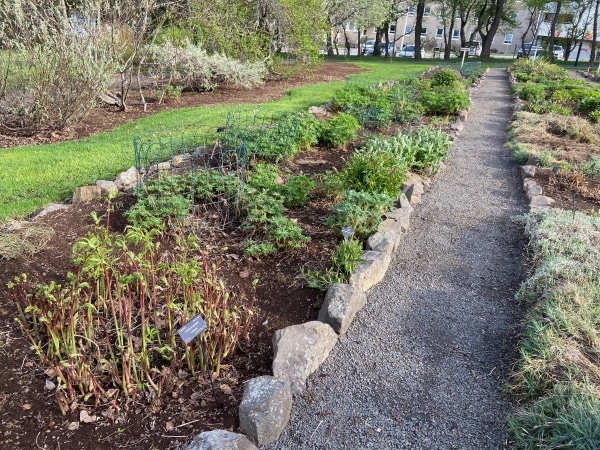
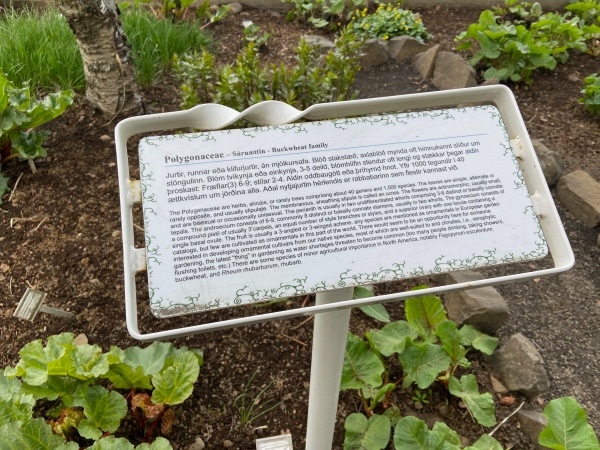
The site is a public park of 3.7 hectares, and it is well-organised with botanically labelled beds laid out in areas, many with a particular focus. Fortunately for us, all of the information is displayed both in Icelandic and in English, and most beds have explanatory details. One area provides a focus on Arctic flora while another is all about Icelandic native species. To my delight a whole border area is dedicated to the dock family, or Polygonaceae, lots of different rhubarb plants and highly medicinal! Invasive and introduced plants are not ignored but given space too. Seed exchange is an important part of the work of the garden alongside a focus on native flora and survival of non-native plants.
Trees and the Icelandic climate
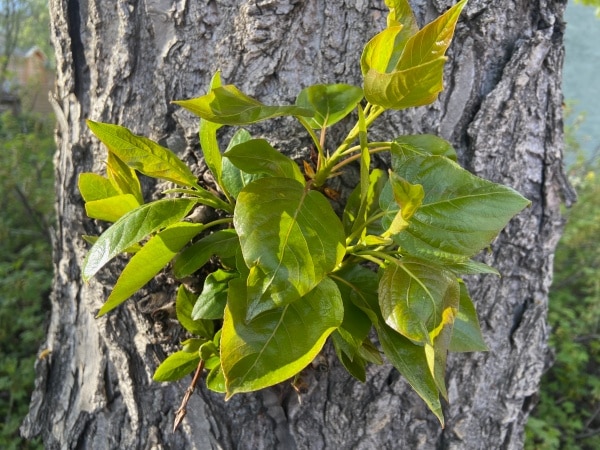
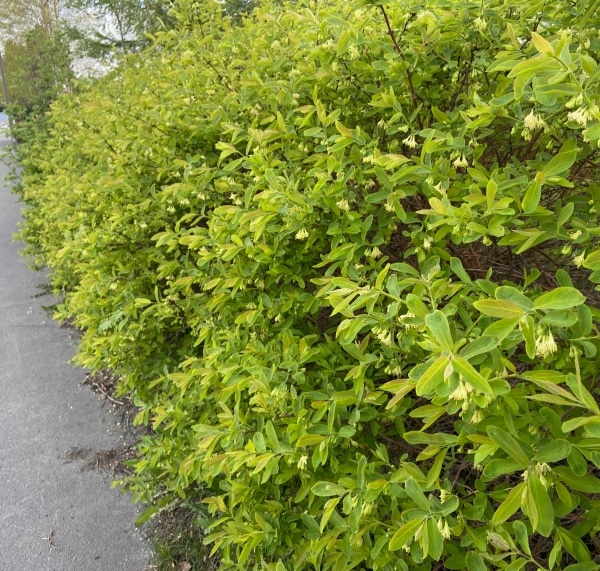
The climate in Iceland is moderated by the Gulf Stream, warm enough to melt the snow caps of many mountains in summer but blanketed in ice and snow in the winter. At Akureyri the winter brings lots of snow and temperatures down to -15 degrees Centigrade. In July the average temperature is 10.9 degrees Centigrade, and the mean number of sun hours per year is 962. The climate is so harsh in winter that trees do not seem to grow especially tall. Some of the trees showed how they survive the extreme cold killing of leading shoots, by sprouting from their stem bark. Iceland as a whole has far less tree cover nowadays than in the past. There were once extensive boreal white birch (Betula pubescens) forests. Soil erosion due to sheep grazing and timber use have seriously depleted the original tree cover to 1%. In some parts the geological freshness of volcanic eruptions and existence of glaciers can be seen in bare and mossy slopes. But Iceland does not feel completely barren as houses in both rural and town areas are well planted around with bushes and trees (there are few fences). Haskap or honeyberry (Lonicera caerulea) shrubs form living hedges. And there is evidence of lots of effort at planting trees in more recent times. From our circular road tour we saw plenty of small and large tree plantations, as well as areas more naturally colonised by birch and willow. We also found plenty of other familiar tree and shrub species including juneberry, juniper, poplar, roses and rowan.
Natives and invasives
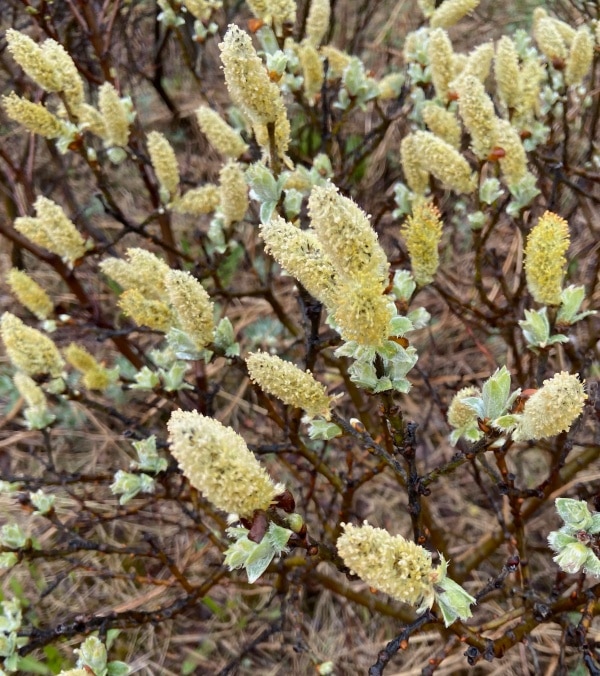
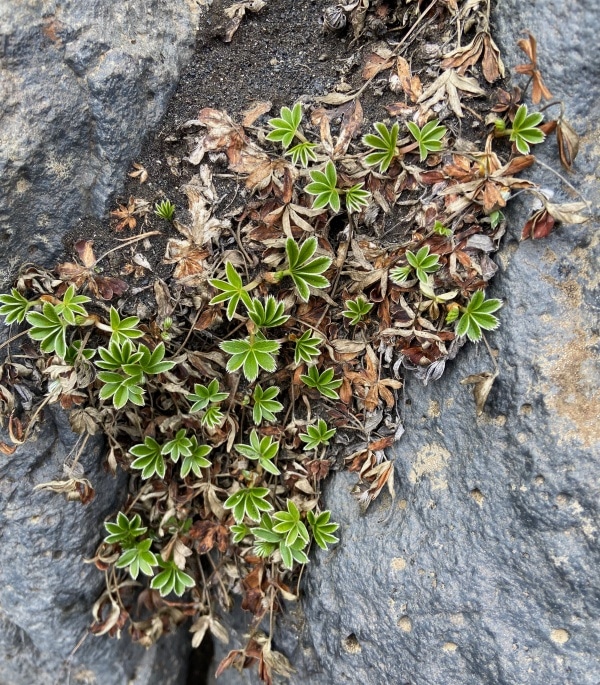
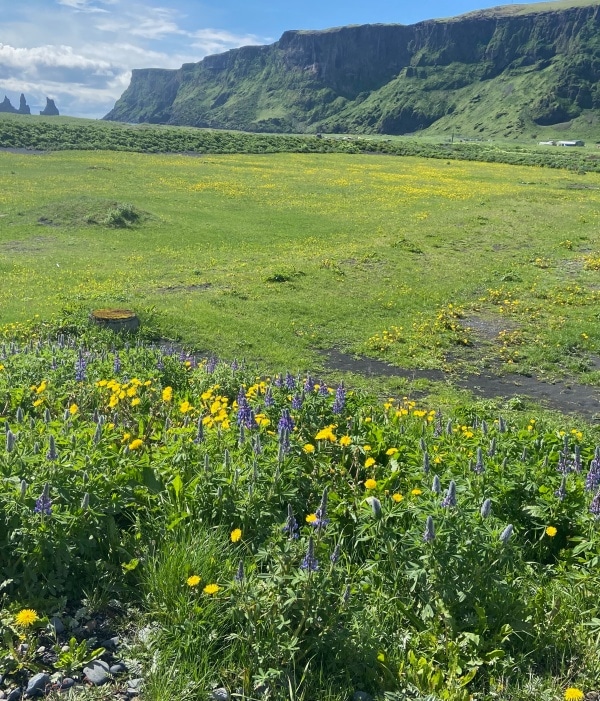
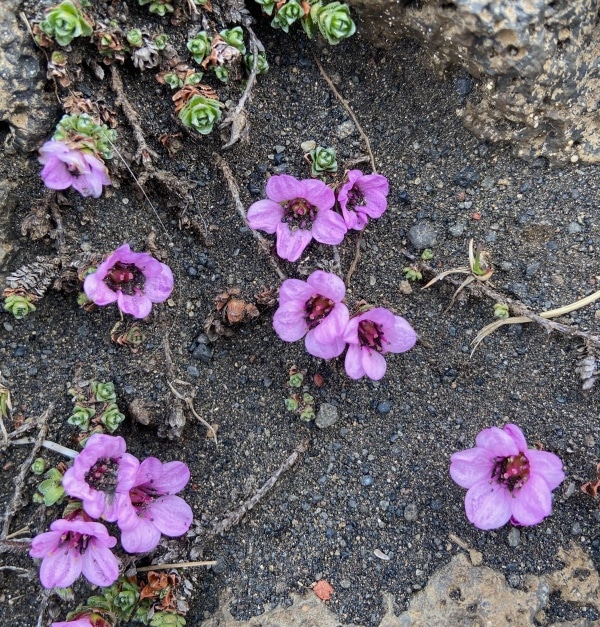
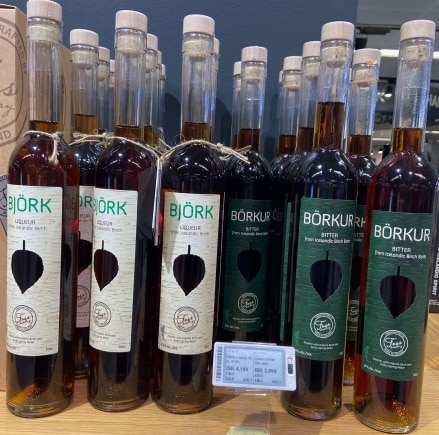
Of course there are some native plants which were new to us. Tiny willows – the Arctic and woolly willows (Salix arctica or Salix lanata) and dwarf birches (Betula glandulosa or Betula nana) were flowering or coming into leaf. Almost everywhere the alpine lady’s mantle (Alchemilla alpina) was underfoot. Efforts to colonise some areas by the Icelandic Forestry Service with a blue-flowering lupin (Lupinus nootkatensis) have somewhat backfired as it could be seen invasively spreading everywhere (interspersed with tall dandelions) as we travelled along the south coast. As we visited in May we delighted in finding the purple saxifrage (Saxifraga oppositifolia) – apparently the flowers are edible and the leaves and stems are used by the Inuit for a herbal tea. Certainly there is plenty of evidence of interest in Icelandic herbs which are available in the shops, including birch liqueur and bitters at Keflavik Aiport!
Getting to the Botanical Garden at Akureyri
The garden was open when we visited in May 2022, although public guides suggest it is only open 1 June to 31 September. It is free to enter. Walking uphill from the centre of Akureyri, the Botanical Garden can be reached within less than 20 min. There is a cafe which stays open evenings in the summer. There is an airport close to Akureyri with flights from Reykjavik City Airport (not the International Airport at Keflavik) taking 45 minutes. For our trip we hired a car in Reykjavik in order to drive around the whole island on Route 1 over 8 days. Icelandair offer flights and good rates for hire cars but note that you need a longer stay as there is so much to enjoy!
Akureyri Botanical Garden website (in Icelandic or English),
http://www.lystigardur.akureyri.is