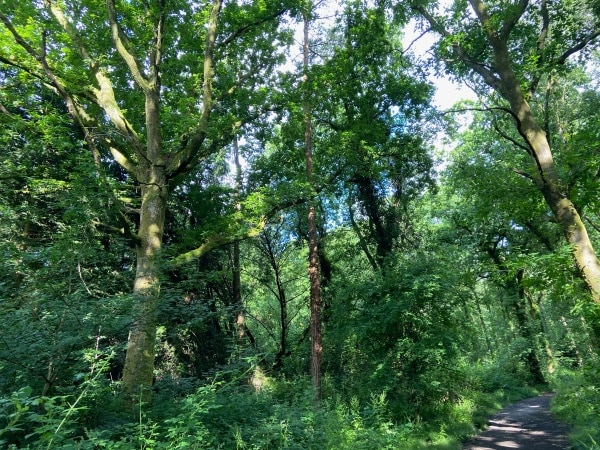
A grade 2 listed country park on the outskirts of Cardiff with many fine botanical specimens of native and introduced trees. While visiting in Wales I have had the opportunity to pay several visits to this rather wonderful country park. It is a grade 2 listed historic park in Wales, laid out in the early 20th century by the Director of the Rhymney Valley Railway, Ernest Prosser. The park contains a wealth of some 100 rare native and exotic trees, and is a noted horticultural site. There are magnolias, oaks, bamboos, southern beech (Nothofagus), conifer and eucalyptus trees. It is worth visiting through the seasons.
History
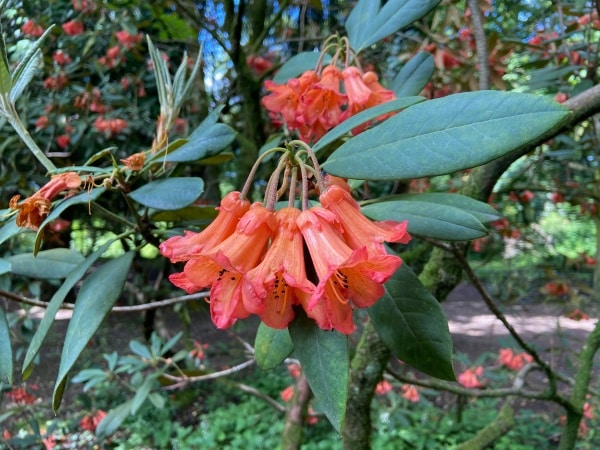
Prosser began in 1911, creating a woodland estate on a site of around 160 acres on The Dingle. He built a summer house for his son Cecil, who had tuberculosis, possibly acquired due to his army service in the 1914-1918 war. Prosser did not go ahead with plans to build a house on the site as Cecil died in 1922, but he maintained the grounds until his death 1933 when the estate was inherited by a nephew. Cardiff Council purchased the estate in 1944, adding further land to the south soon afterwards. They retained the previous head gardener, Tom Jenkins, who had laid out the original paths, plants and trees, including a swimming pond. The remains of a changing room built of railway sleepers originally with a conical thatched roof can still be seen. Later on the pool was used by memebrs of a nearby golf club but it is no longer in use. Many azaleas and rhododendrons were planted just before the first world war and in the 1920s. The park became incredibly popular for the spring displays of azaleas and rhododendrons. These do well in the acidic soil, some even flowering as late as my visit in June.
Management of the park
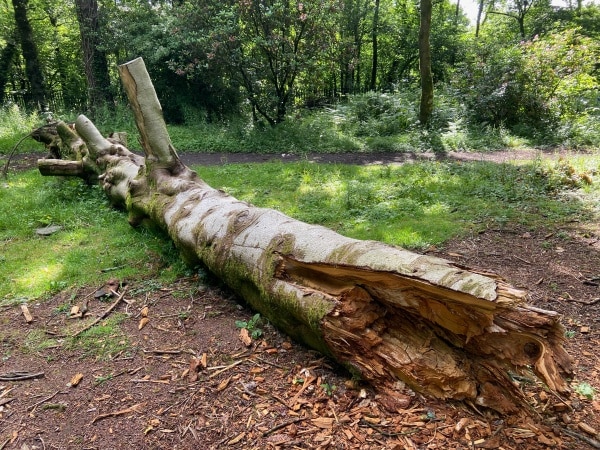
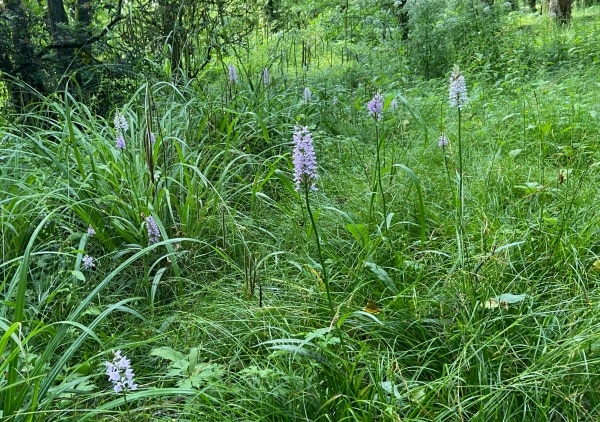
Management cannot be easy as there are many large trees, close together, some vulnerable to weather and disease. And apparently an outbreak of Phytophthora ramorum was discovered in 2005 so there has been a programme of tree clearance to eradicate the problem. There is not too much intervention otherwise and it is good to see some fallen trees staying put, and some areas left uncut for orchids to grow!


Walking up through the dell
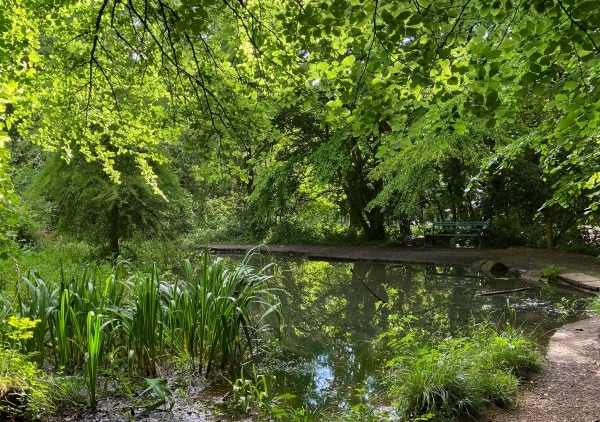
This park is like a long and large woodland dell. On entering the park, the path soon passes under the motorway (M4 to London). To the left there is a large area of woodland which has been allowed to naturalise. There are a number of waymarked routes around the woodland. You are never far from the motorway but provided with a cool escape walking up the valley as there are three ponds: the lily pond with a swamp cypress (Taxodium distichum), the swimming pond (rather silted up), and the Lysichiton pond which used to contain skunk cabbage (Lysichiton americanus). This plant was removed in the 1980s, perhaps because it was feared invasive. In its native land of North America, the roots of skunk cabbage were used as an antispasmodic remedy in dry coughs and asthma, the leaves were an effective poultice.
Medicinal and significant trees
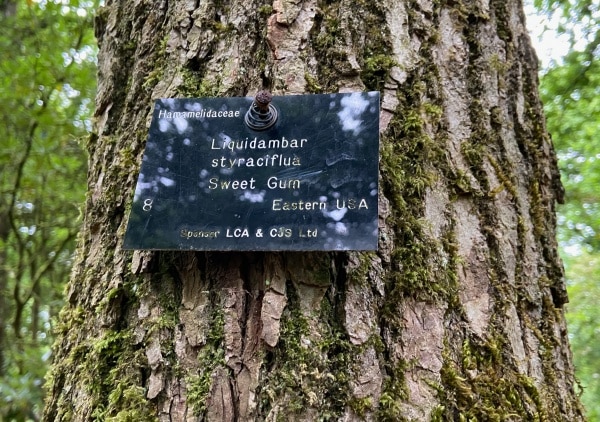
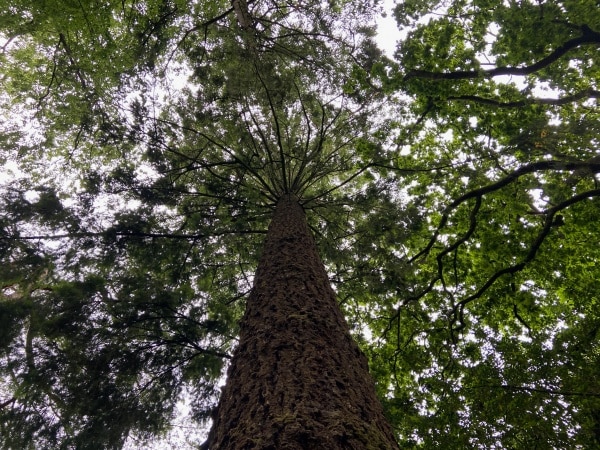
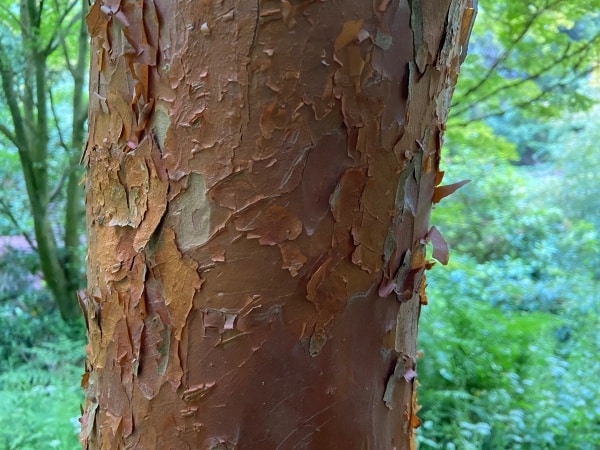
For me, the interest as always is in the medicinal trees. Fortunately some of the trees are still labelled. A leaflet can be downloaded with a map. I like to see what these trees can become, here some are quite magnificent. The sweet gum (Liquidambar styraciflua) is a most aromatic plant. Another favourite is Western red cedar (Thuja plicata) which has gorgeous piney foliage. And Douglas fir (Pseudotsuga menziesii) is a tree that I love, albeit not at quite such stupendous size as you can barely see the leaves of this tree let alone harvest them for a tasty tea. But some trees are simply admirable for their looks. You can see the most beautiful bark on the Tree of Heaven (Stewartia pseudocamellia) from Japan and Korea – though I have not found a medicinal use yet. A list of 40 significant trees is available online and some of the trees are champions.
Visiting Parc Cefn Onn
Overall this is a country park worth repeat visits through the seasons as there is always something to discover of interest, especially if you are a treehugger like me! If you are nearby there are opportunities to get involved too. Since 2010 there has been a Friends of Cefn Onn Group which has welcomed volunteers for a few hours every month on workdays. They carry out projects in addition to the ongoing Cardiff Council upkeep. Projects have included planting bulbs, cleaning out ponds, repainting park benches, and more.
Parc Cefn Onn, Cherry Orchard Road, Lisvane, Cardiff, CF14 0EP
The Cefn Onn country park is open from 7 am daily until half an hour before sunset. Free parking spaces are on site. Alternatively this park can be reached by train as it is a few minutes walk from the Lisvane and Thornhill railway station. Trains run from Cardiff Central frequently, the journey takes about 15 min.