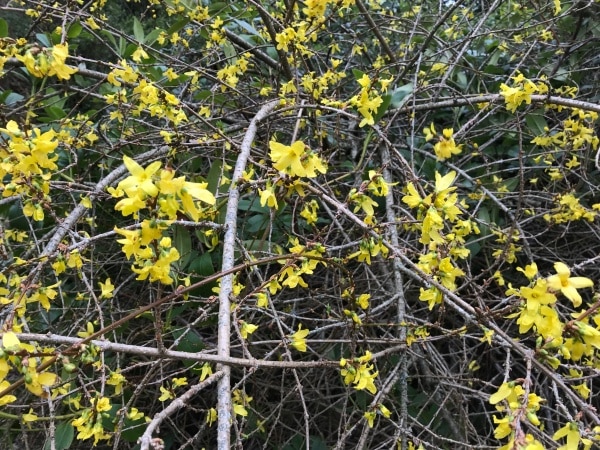
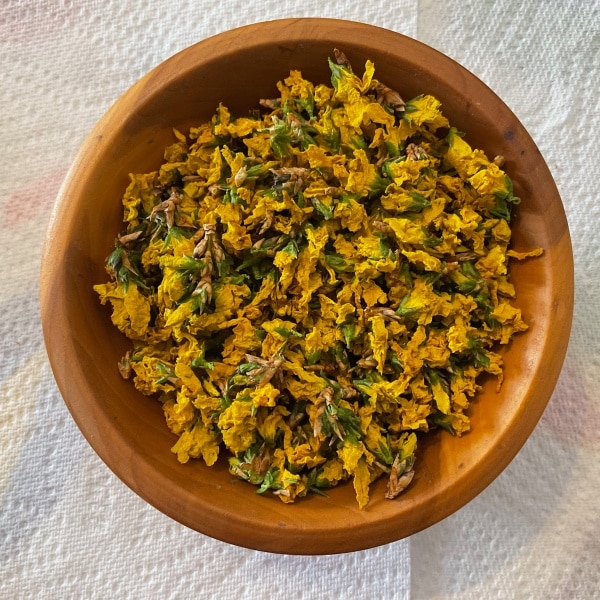
Medicinal flowers are all around! It seems like forsythia pops up everywhere I go! It is commonly planted as a garden ornamental and the bright yellow medicinal flowers start to appear in March about the same time as daffodils. The flowers and subsequent leaves offer healing benefits including help for respiratory complaints. They can be dried for later use.
Origins
Forsythia (Forsythia suspensa) gives us an arching hardy shrub with abundant yellow spring flowers and fruits used in numerous traditional Chinese medicine formulas. It is a member of the olive (Oleaceae) family. It is a deciduous shrub originating from eastern Asia to China, a plant that forms thickets on hillsides and in woodland margins. Brought to Europe in the nineteenth century and most commonly today it is the hybrid Forsythia x intermedia that is planted in gardens as an ornamental, thought to derive from F. suspensa and F. viridissima. F. suspensa has spreading weeping stems with pale flowers and F. viridissima flowers a bit later.
Description
This is a deciduous variable and somewhat straggly shrub with multiple stems and spreading branches growing to 3-4 m tall up to 4 m wide. Copious yellow flowers are produced in March-April before the leaves, and they are pollinated by insects, mostly bees. The fruits are narrow capsules with two chambers produced from July to September, though these are not readily produced in most European countries. Most forsythia species will grow in a range of soils and appreciate sun.
Traditional use
Forsythia is a bitter tasting and pungent herb, one of the 50 fundamental herbs in Chinese traditional medicine, used for clearing heat and detoxification in formulae for childhood fevers, acne and skin infections. The fruits have been used to treat fever, inflammation and other conditions. The leaves and twigs have been used in decoction to treat breast cancer. In Chinese traditional medicine the fruit is harvested in two forms, when green and starting to ripen (Qing Qiao) and when yellow and fully ripe (Lao Qiao). However in Europe we often see only the flowers and the leaves.



Herbal actions
Forsythia medicinal flowers and leaves are reported to be anti-inflammatory, bitter, astringent, antiobesity, antioxidant, antibacterial, antiviral, laxative, diuretic, hepatoprotective, neuroprotective and tonic. Lignans and phenylethanoid glycosides are considered as the characteristic and active constituents of this herb, such as forsythiaside, phillyrin, rutin and phillygenin. The levels of phillyrin are highest in the leaves.
Indications and research
The flowers have broad spectrum antibacterial action, and can be used to help the treatment of acute infectious diseases such as colds and sore throat. The leaves are used in formulas to treat obesity and as an anti-inflammatory poultice for ulcerated glands or haemorrhoids. Anti-inflammatory and antioxidant properties of the seed contribute to the anticancer and neuroprotective properties attributed to the fruits. Research into the more widely grown garden plant Forsythia x intermedia has identified that the flowers and leaves are a potentially valuable source of active lignans of use in inflammatory diseases with excessive production of cytokines.
Ways to use forsythia
Flowers can be eaten as a bitter garnish in salads. An infusion of the edible flowers can be made into syrup or jelly. An infusion of flowers can be used for a cleaning antiseptic face wash. The leaf infusion may be helpful as a gargle for a sore throat, and taken as a tea during colds and flu.
Safety
For safety avoid use in breastfeeding or pregnancy. Forsythia may slow bloodclotting and it should be avoided alongside anticoagulants or before surgery. Always consult an experienced herbal or medical practitioner if you are seeking to use forsythia alongside prescription medication.
More information
If you would like to learn more about how healing trees and shrubs work then check out our short online course ‘Medicinal Trees and Their Healing Properties’, more details …
References
Michalak B, Filipek A, Chomicki P, et al. Lignans from Forsythia x intermedia leaves and flowers attenuate the pro-inflammatory function of leukocytes and their interaction with endothelial cells. Front Pharmacol 2018; 9: 401.
Nishibe S, Mitsui-Saitoh K, Sakai J, et al. 2021. The biological effects of forsythia leaves containing the cyclic AMP phosphodiesterase 4 inhibitor phillyrin. Molecules 2021: 26: 2362.
Wang Z, Xia Q, Liu X, et al. Phytochemistry, pharmacology, quality control and future research of Forsythia suspensa (Thunb.) Vahl: A review. J Ethnopharmacol 2018; 210: 318-339.
Xu X, Saadeldeen FSA, Xu L, et al. The mechanism of phillyrin from the leaves of Forsythia suspensa for improving insulin resistance. BioMed Research International 2019; 2019: 3176483.
Zhou C, Lu M, Cheng J, et al. Review on the pharmacological properties of phillyrin. Molecules 2022; 27: 3670.
For more references on research studies on medicinal trees and shrubs see The Medicinal Forest Garden Handbook by Anne Stobart, available from good booksellers, or from the Medicinal Forest Garden Trust here…